Finding Critical Security Vulnerabilities In Widely Used Research And Scientific Software For Fun Not Profit, HDF5 Story
Published: 04/12/2026
Since A.D. 2009 I have been discovering and reporting critical security vulnerabilities in high profile scientific software, developed and used mostly by NASA for Earth and Space scientific missions and observation, but also used by thousands of other academic, defensive, aerospace, government, research and commercial companies and government agencies mostly in the USA, but also across the world.
These days I don’t do much security research any more, I did everything that I wanted in the area of cybersecurity since I entered it as a curious kid and much, much more than I could have ever imagined when I was a teenager. Now I am leading my latest cybersecurity company with 25+ years of experience in the cybersecurity industry and just trying to enjoy life.
But now and then brief and sudden intellectual craving emerges to do something new, and to prove myself that I still have that hacker’s spirit and to shake off that dust off of my hacking talent.
Stay with me if you want to find out about a vulnerabilities in HDF5 software from HDFGroup which is according to Google Gemini being used in research and data processing by high-profile organizations and companies like CERN, NASA, ESA, SpaceX, Boeing, Lockheed Martin, Google, Meta, Shell, Wall Street, AI/ML community and many more…
Almost a year ago I was reading an article about various software for storing massive, unimaginable amounts of data and processing them for various purposes, used by the largest tech and scientific giants in the world.
I’ve stumbled across HDF5 software (https://www.hdfgroup.org/), abbreviation for Hierarchical Data Format version 5, something that I, to be honest, never heard of before.
As it sparked my curiosity, I’ve asked a quick question to Google Gemini about HDF5 software and here is what Gemini said.
HDF5 is the "industrial-strength" backbone for many of the world's most data-intensive organizations. Because it can handle massive datasets (petabytes) and is highly portable, it is used by both government giants and private innovators.
Here are the most prominent agencies and companies that rely on HDF5:
These organizations use HDF5 primarily for long-term archiving and sharing massive scientific observations.
In the private sector, HDF5 is the "quiet workhorse" behind engineering and financial simulations.
|
Sector |
Key Use Case |
Why HDF5? |
|
Space/Science |
Satellite Imagery |
Long-term archiving & portability |
|
Engineering |
Flight Testing |
Handles heterogeneous data (video + sensors) |
|
Finance |
Market History |
Extremely fast random access (slicing) |
|
AI/ML |
Training Models |
Efficient storage of multidimensional tensors |
What is actually the HDF5 data format? Without bothering you with too many boring details, HDF5 is according to Gemini:
In short: HDF5 is a high-tech suitcase that lets scientists pack massive amounts of different types of data into one organized, fast, and easy-to-carry file.
BINGO!
Since all of these high profile companies and organizations are using HDF5 software, mostly in high profile scientific research and data processing, it definitely looks like an interesting target to the hackers in order to compromise their systems for stealing highly classified research data, industrial espionage or a foothold into the internal network.
Moreover, the core of HDF5 software is written in C, programming language which implies that there could potentially lurk all sorts of memory related security issues and vulnerabilities in the core of the HDF5 software itself.
I’ve decided to give it a shot, 8 hours of my spare time.
HDF5 source code can be downloaded from the HDFGroup vendor - https://www.hdfgroup.org/ .
When I downloaded HDF5 source code, I quickly started to do manual analysis of most common pitfalls in software applications written in C while processing data from various file formats.
I have spent roughly an hour getting more familiar with source code architecture and structure, then I started to look into parts which actually does data processing of file formats.
I’ve quickly stumbled across the /tools/src/h5import/h5import.c command line tool used to read raw data from text or binary input files and convert them to the HDF5 format.
It actually defines how data should be stored in HDF5 format, which sizes are required, data types and metadata information.
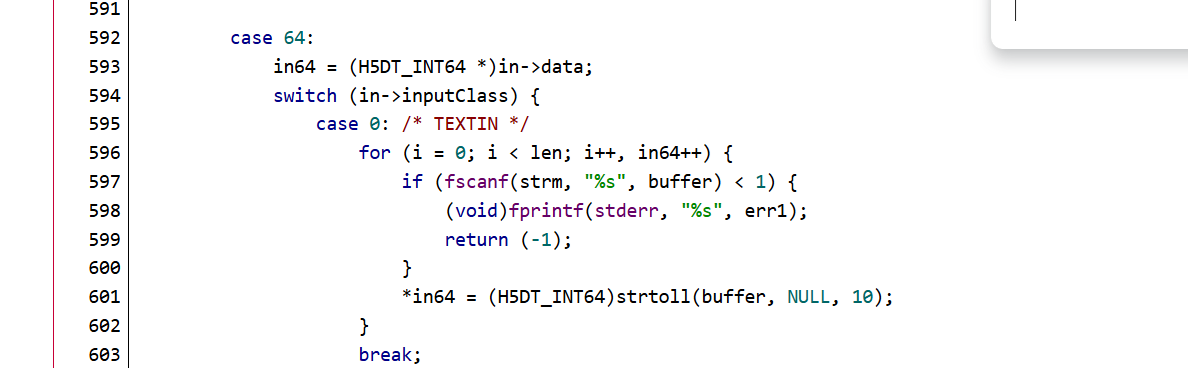
Quick analysis of the h5import.c guided me to this interesting code snippet - fscanf() without boundary checking on the code line 597.
These sorts of things are very common programming pitfalls in C. fscanf() is an inherently insecure C function if not used with proper format string boundaries.
Previous code snippet is part of function readIntegerData(FILE *strm, struct Input *in)
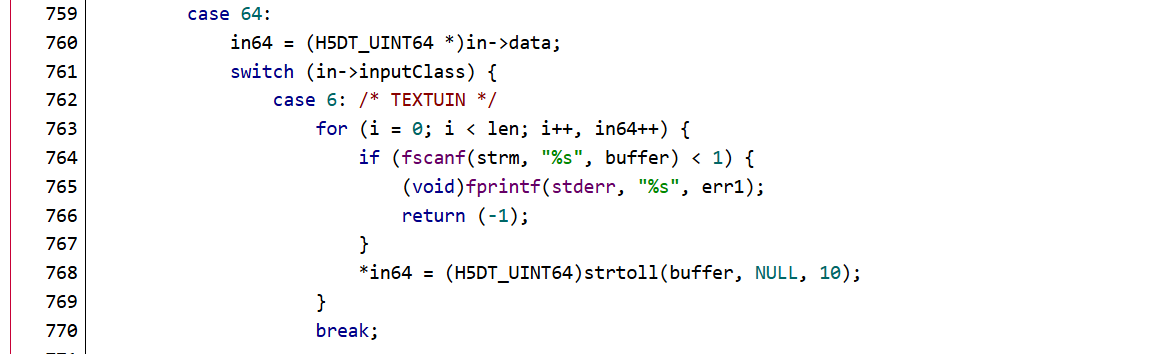
Pretty much the similar vulnerability can be also found in the same file on the line 764 in the following code snippet from readUIntegerData(FILE *strm, struct Input *in)
The main difference between these two functions is that one is processing signed and the other unsigned integer data from the data file provided by the user, or maybe a malicious threat actor.
Since both functions and vulnerabilities are pretty much the same and have similar code path for exploitation, for the sake of length of this publication, we will examine first one - readIntegerData(FILE *strm, struct Input *in).
They are both called from the same parent function - processDataFile(char *infile, struct Input *in, hid_t file_id)
Function readIntegerData() takes data from the FILE stream of the file name provided to h5import.c at the command line.
Let’s get back to the readIntegerData(FILE *strm, struct Input *in) and first vulnerability.
As stated before, vulnerability itself is located on line 597, where input data from file is being read into the buffer variable using insecure fscanf() function into the variable located on stack without boundary checking. Shortly after that on line 601 data from input file is being converted to 64 bit signed integer using strtoll() function, and stored to the location where in64, 64 bit pointer to the heap is directed towards.
In the good old days, fscanf() buffer overflow would usually be all that we would need with little bit of trickery to overwrite return address and exploit buffer overflow to take control of the Instruction Pointer hence EIP/RIP register.
But simple good ol’ days are long gone, so let’s check how variables are organized on stack.
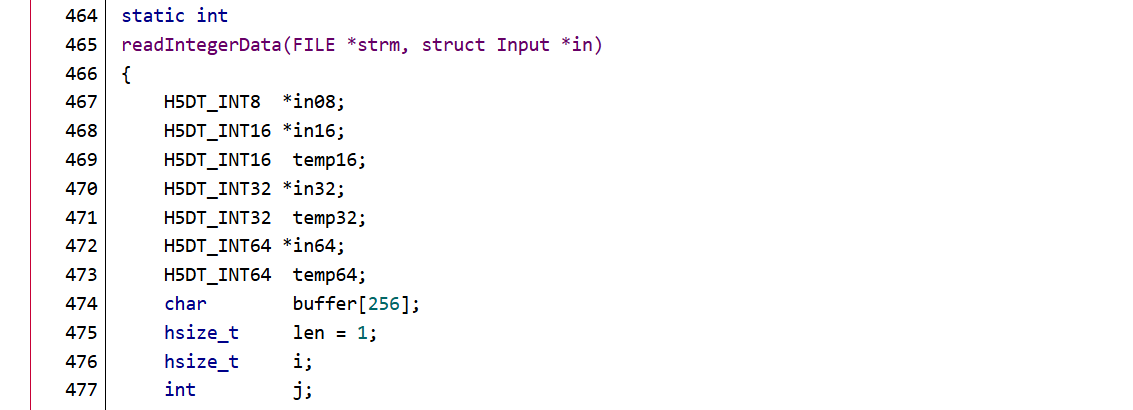
As we can see on the line 474, our buffer variable which can be overflowed is 256 bytes, located on the stack memory right above the temp64, 64 bit signed integer, which is not important for exploitation and above the in64, 64 bit pointer towards the memory allocated on heap, which is very important for the exploitation.
That is usually the case unless the compiler does some optimization or realignment, but in normal circumstances that should be the stack layout.
In good ol’ days, we would with a little trickery overwrite the Instruction Pointer or in64 pointer on the stack (or SEH handler on the Windows) and point it towards the return address on stack to overwrite it or directly towards our shellcode.
As I said, the good ol’ days are long gone.
To exploit this vulnerability and take full control over the process, we now need to defeat various memory protection mechanisms and mitigations, even different ones since HDF5 is being distributed for Linux, Windows and MacOS which all have somewhat different security mechanisms for protection from memory corruption vulnerabilities.
One thing that is common and first most important line of defense is ASLR (Address Space Layout Randomization) which prevents us from blindly setting hardcoded memory address to overwrite, since upon every start of the process or system boot, base addresses for stack, heap, libraries, etc. are being randomized over and over again.
We either need some memory information leak to defeat ASLR which is unlikely in this case of data file processing security vulnerability in the command line tool, or we would have to try to think of something else.
So far what we know is that we can overwrite in64 64 bit pointer located on stack below the buffer variable, in64 pointer pointing towards the heap, but since stack and heap base address is randomized, overwriting complete in64 with some hardcoded address would lead us to memory violation / segmentation fault and crashing the program.
601: *in64 = (H5DT_INT64)strtoll(buffer, NULL, 10);
The previous line is the key to the potential evasive solution for ASLR randomization.
After the buffer is being overflowed with user/malicious data, it is possible to also overwrite the in64 pointer which is on the stack below the buffer and points to the heap.
If complete in64 is overwritten, the process will 99,99% crash, but what came across my mind is one rather old technique used when buffer overflow is somehow limited or there is no way of memory leak, like in this case with ASLR - partial overflow even without memory information leak.
Partial overflow is a well known technique for defeating ASLR in specific cases.
ASLR usually randomizes base address, but lower 12 bits of memory address or 4Kb memory page usually always have predictable offsets.
So instead of completely overwriting an in64 pointer, it is possible to overwrite the buffer on stack and overwrite only 2 bytes or single LSB (Least Significant Byte) of in64 pointer to target some other interesting data or structure in the memory within the same predictable memory page offset.
601: *in64 = (H5DT_INT64)strtoll(buffer, NULL, 10);
So first part of exploitation would be to exploit that fscanf() stack buffer overflow to overwrite buffer, temp64 and just 1-2 bytes of in64 64 bit pointer which will make it in the previous code line, in the second part, possible to overwrite data on some predictable memory address other than what it is meant to write to.
Data which is being written to in64 is also coming from user input - buffer filled with data from the user/hacker controlled input file read with vulnerable fscanf() and later written to some memory location as it can be seen on the previous code line 601.
From the hackers point of view, since HDF5 input file format can contain various data types, various sizes and formats, it is possible to play around with a memory and alignment in order of how it is processed and allocated which increases the chances of grooming, finding and hitting something useful to overwrite.
Basically this vulnerability could be exploited by a specially crafted malicious input file processed by h5import.c command line tool for converting data to HDF5 format.
I’m now leaving further exploitation analysis and research for an interesting data to overwrite and take this vulnerability to its full potential for a curious reader.
07/18/2025 - Initial contact with the vendor - HDFGroup
07/18/2025 - Vulnerability details sent to the vendor
10/02/2025 - Vulnerabilities fixed and PR request closed
10/02/2025 - Vulnerability case closed, new fixed version available from HDFGroup
04/13/2026 - Public disclosure
You might be interested why I waited months for public disclosure?
Since all that information from Google Gemini that HDF5 software is being used in research and data processing by high-profile organizations and companies like CERN, NASA, ESA, SpaceX, Boeing, Lockheed Martin, Google, Meta, Shell, Wall Street, AI/ML community and many more… and the potential high or even critical severity of the vulnerabilities, I’ve decided to postpone public disclosure a little bit longer than usual before going public with it.
I would like to thank for the support and encouragement in my business and research endeavours especially to my family, colleagues in ThreatLeap and RNTrust - and of course to all of my friends, you know who you are 🙂